Table of Contents
If you’ve spent any time in digital marketing over the past couple of years, you already know something has shifted. It’s not just another buzzword cycle. The future scope of digital marketing is being rewritten in real time, and the biggest driver behind that shift is AI — not as a distant trend, but as something already sitting inside daily workflows.
I’ve been working in digital marketing for a few years now as a generalist, which means I’ve had my hands in everything from ad copy to content to reporting. And the change I’ve felt most directly isn’t in some far-off “future of marketing” prediction. It’s in something as simple as how many ad variations I can test in a single afternoon.
Why AI Is the Real Story Behind Digital Marketing’s Future
A lot of articles talk about the future of digital marketing in abstract terms — automation, personalization, data-driven everything. That’s not wrong, but it misses the practical, ground-level shift that’s already happening.
Here’s a concrete example. Before AI tools became part of my regular workflow, testing ad creative meant writing two or three variations, running them, waiting for results, then manually tweaking based on gut feeling and whatever data trickled in. It was slow, and it limited how much you could actually learn from a campaign.
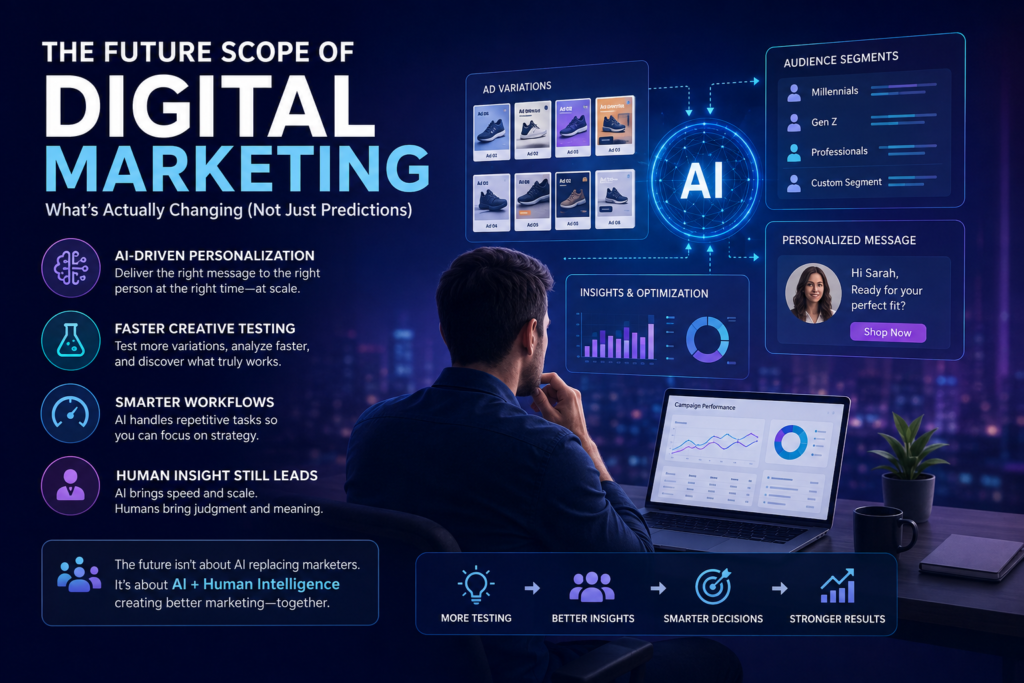
Now, that same testing process regularly involves ten or more variations run in parallel. That’s not a small efficiency gain — it’s a completely different way of approaching creative testing. Instead of guessing which one or two angles might work, you can let the data show you patterns across a much wider set of options.
This is the part of the “future scope of digital marketing” conversation that often gets skipped: it’s not just that AI writes copy faster. It’s that AI changes the scale at which marketers can experiment, which changes the quality of decisions they’re able to make.
AI-Driven Personalization at Scale: The Trend That Matters Most
If I had to pick one trend that will shape the future of digital marketing more than any other, it’s AI-driven personalization at scale.
For years, “personalization” in marketing meant segmenting an email list into three or four groups and calling it a day. That’s changing. AI now makes it realistic to tailor messaging, offers, and even creative to much smaller audience segments — sometimes down to the individual level — without multiplying the manual workload.
This matters because audiences have gotten better at tuning out generic marketing. A broad, one-size-fits-all campaign increasingly reads as noise. Personalization at scale is how brands stay relevant without needing an army of marketers manually customizing every touchpoint.
That said, this trend comes with real limitations worth being upfront about. Personalization only works if the underlying data is accurate and if privacy expectations are respected. Marketers who rush into hyper-personalization without solid data practices risk creating experiences that feel invasive rather than helpful. This is a genuine trade-off, not a solved problem, and it’s worth researching current data privacy regulations before scaling any personalization strategy
The Mistake I See Marketers Make With AI Tools
Speed is the obvious benefit of AI in marketing. It’s also where the biggest mistake tends to show up.
The mistake I see most often — and one I’ve had to actively guard against myself — is over-relying on AI without human review. It’s tempting to let AI-generated ad copy, personalization rules, or content go live because it was fast to produce and looks reasonable on the surface. However, “reasonable on the surface” is not equivalent to “accurate,” “on-brand,” or even “aligned with what the audience actually needs.”
AI tools are excellent at generating volume and speeding up iteration. They’re not yet reliable at understanding nuance, brand voice, or the specific context a human strategist brings to a decision. Skipping that human review step is how brands end up with off-tone messaging, factual errors, or personalization that misses the mark entirely.
A simple rule that’s worked well: use AI to widen the pool of options, but keep a human checkpoint before anything goes live. The speed gain from AI should apply to testing and iteration — not to skipping judgment.
What This Means for the Future Scope of Digital Marketing
Putting these pieces together, here’s a realistic picture of where digital marketing is headed:
Shift What’s Changing What Stays the Same
Creative testing Volume of variations tested increases significantly Strategy still needs a clear hypothesis before testing
Personalization Moves from broad segments to near-individual targeting Data accuracy and privacy compliance remain essential
Workflow speed AI compresses production time for copy and creative Human review and brand judgment remain non-negotiable
Marketer’s role Shifts from producer to editor and strategist Core skill of understanding audience intent still matters most The throughline across all of this is that AI is expanding capacity, not replacing judgment. Marketers who treat AI as a tool for scale — more testing, more
Common Questions About the Future Scope of Digital Marketing
Will AI replace digital marketers? Based on current, practical use in workflows, AI is replacing specific tasks — like generating first-draft ad copy or producing multiple creative variations — rather than replacing marketers themselves. The strategic and review work still needs a human.
Is AI-driven personalization worth the investment for smaller businesses? It depends on data maturity. Personalization at scale requires reliable audience data. Businesses without that foundation yet may get more value from improving data collection first before layering in advanced personalization.
What’s the biggest risk in relying on AI for marketing? The biggest risk is treating AI output as final rather than a first draft. Skipping human review is where errors, off-brand messaging, and misaligned personalization tend to creep in.
Final Takeaways
The future scope of digital marketing isn’t some distant, theoretical shift — it’s already visible in daily workflows, from how many ad variations get tested to how personalized a customer’s experience can be. AI-driven personalization at scale looks set to be one of the defining trends, but it only works when paired with solid data practices and consistent human review.
If you’re adopting AI tools in your own marketing work, the practical takeaway is simple: use AI to expand what you can test and personalize, but don’t remove the human checkpoint that keeps quality and judgment intact.